A 16th century Mexican Featherwork Chalice Cover
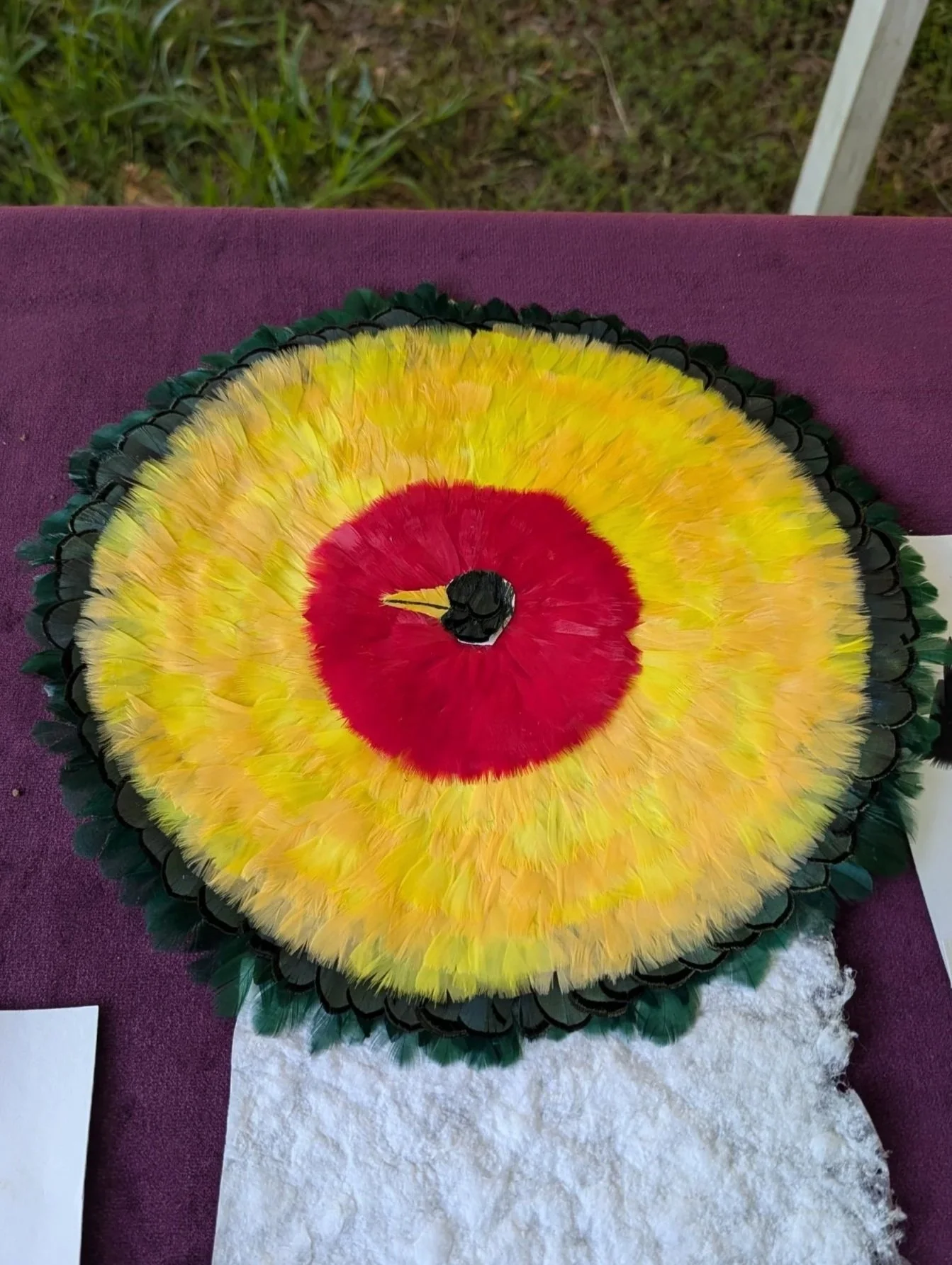
For the theme of borderlands and first cultural contacts (Skewered 2026), I chose to create a mosaic feather work chalice cover based off a surviving piece dating to the mid 16th century.
The decades after the Spanish conquest of the Mexica lead triple alliance, Catholicism quickly took hold of daily life. The craftsmen that once made the prized feathered items that adorned images of the gods and highest levels of Mexica society pivoted to serve their new patrons and conquerors. Adapting their skills and motifs to glorify the god brought by Cortez and those that followed.
While I chose to make an original design, my design similarly uses indigenous iconography to serve a new purpose for a new faith. Drawing from the syncretization of Huitzilopochtli and Jesus, I chose a hummingbird motif on a red and yellow background to evoke the blood of sacrifice and sun associated with both deities.
As a secondary goal I used this project to trial accessible alternatives to the orchid root glue that would have been used at almost every step of this process. In a previous project I used a period appropriate alternative (rabbit hide glue), but I wanted to try some options that would be closer in properties. I landed on a combination of wheat paste and a polysaccharide, called glucomannan, that's found in other species of orchid. This worked similarly to the rabbit hide glue and I'm fairly happy with its performance.
Overall, I'm pleased with what I learned during this project and have refined my workflow for mosaic feather work compared to my earlier attempts. In the future I'm hoping to source better alternative materials and to find better solutions to prevent warping.
Documentation: https://docs.google.com/document/d/1lW0EEanyrBziINzWKPfScUAg9GoV-l6wSV3jMH7wq0c/edit?usp=sharing